

INNOVATIV
Band 79: Janet Wagner Band 78: Philip Franklin Orr Band 77: Carina Dony Band 76:
Linda Freyberg
Sabine Wolf (Hrsg.)
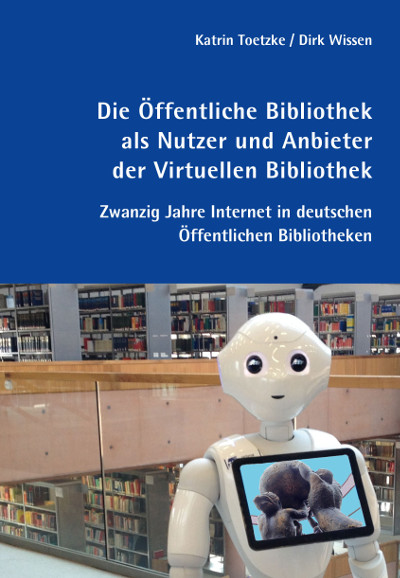
Band 75: Denise Rudolph Band 74: Sophia Paplowski Band 73: Carmen Krause Band 72:
Katrin Toetzke
Dirk Wissen
Band 71: Rahel Zoller Band 70: Sabrina Lorenz Band 69: Jennifer Hale Band 68:
Linda Schünhoff
Benjamin Flämig
Band 67:
Wilfried Sühl-Strohmenger
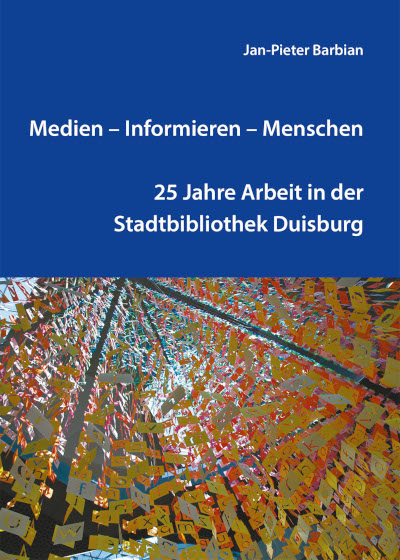
Jan-Pieter Barbian
Band 66: Tina Schurig Band 65: Christine Niehoff Band 64: Eva May Band 63: Eva Bunge Band 62: Nathalie Hild Band 61: Martina Haller Band 60: Leonie Flachsmann Band 59: Susanne Göttker Band 58: Georg Ruppelt Band 57: Karin Holste-Flinspach Band 56: Rafael Ball Band 55: Bettina Schröder Band 54: Florian Hagen Band 53: Anthea Zöller Band 52: Ursula Georgy Band 51: Ursula Jaksch Band 50: Hermann Rösch (Hrsg) Band 49: Lisa Maria Geisler Band 48: Raphaela Schneider Band 47: Eike Kleiner
Bestellen Sie jetzt online!
24. April 2026
  WEITERE NEWS
Aktuelles aus
L
ibrary
Essentials

In der Ausgabe 03/2026 (April 2026) lesen Sie u.a.:

  • Nationales Kultur­erbe unter Druck: Der Stopp des DNB-Erweiterungsbaus und seine Folgen
  • Entwicklungen im Medienalltag
  • Vom Datenhype zur Datenkompetenz: Warum Data Literacy zur Kernaufgabe
    von Bibliotheken wird
  • Warum Bibliotheken bei KI, Lizenzen
    und Fair Use mitreden müssen
  • Entwicklungen für die Zukunft
    von Bibliotheken
  • Forschungsdaten als Publikationsform
  • Wie Forschende mit KI-gestützten Recherchetools arbeiten
  • KI-Erschöpfung und „Vocational Awe“
    in wissenschaftlichen Bibliotheken
  • Aufmerksamkeitskrise oder Designproblem? Was Bibliotheken aus der Debatte über Lesen und Bildschirme lernen können
  • Die Stiftsbibliothek St. Gallen:
    Ein 1.300 Jahre altes Wissensarchiv
  • Bibliotheken als Räume für Wohlbefinden
    im Gesundheitswesen
  • Das Ende eines Formats: Der Niedergang des Massenmarkt-Paperbacks
u.v.m.
  fachbuchjournal
2009 bis 2023

CAUL and Taylor & Francis announce new open access agreement for Australasian researchers

Partnership expands to cover full OA journals, AI use and journal OA conversions

From January 2026, researchers in Australia and Aotearoa New Zealand will have an expanded range of open access (OA) publishing options through a new three-year agreement negotiated by the Council of Australasian University Librarians (CAUL) and Taylor & Francis.

The comprehensive agreement ensures all articles by researchers at participating institutions will be published OA in Taylor & Francis and Routledge journals. For the first time, the partnership supports researchers choosing to publish in fully open access journals, in addition to articles in hybrid titles.

Taylor & Francis has also announced that the partnership will enable the expansion of its OA collective funding model, Collective Pathway to Open Publishing. With sufficient support, several humanities and social sciences journals with a high proportion of Australasian authors will convert to open access for at least their 2026 volumes, including Journal of the Australian Library and Information Association, published on behalf of the Australian Library and Information Association. If implemented, researchers around the globe will be able to publish OA in these titles, without paying an article publishing charge.

As well as providing continued read access to Taylor & Francis’ world-leading journals portfolio, the partnership recognizes the increasingly important role of Artificial Intelligence in today’s teaching and research. The expanded agreement will permit use of licensed Taylor & Francis proprietary content in connection with AI technologies, with appropriate safeguards, for non-commercial research and educational purposes. This might include, for example, a researcher using AI tools to summarise journal articles for teaching preparation or to generate discussion questions.

“We have been really pleased by the way Taylor & Francis has approached the negotiations with a real willingness to listen, engage and come to the table with a commitment to meeting the sector’s needs – both in terms of open access publishing, but also managing expenditure,” said Arthur Smith, Associate Director, CAUL Content Procurement. “Establishing the CAUL Open Access Negotiation Strategy Committee (COANSC) with Universities Australia, and Universities New Zealand has been instrumental in achieving these outcomes. It demonstrates what can be accomplished when we work together with a clear, shared vision.”

“CAUL and its member institutions are an essential partner for Taylor & Francis in sustaining, accelerating, and innovating in our approach to open research, across our journals and books publishing - especially during a period of change and challenge for higher education globally,” said Alex Robinson, Chief Commercial Officer at Taylor & Francis. “The collaborative negotiations that have taken place with COANSC, in a spirit of partnership and open discussion, have led to what we believe is a shared vision of expanded open access through an enduring and sustainable agreement.”

Professor Iain Martin, Vice Chancellor of Deakin University and Chair of COANSC, said, “The successful agreement with Taylor & Francis demonstrates that when universities and publishers come together in true partnership, they can deliver outcomes that benefit researchers, institutions, and the broader community through expanded open access to scholarly knowledge.”

https://taylorandfrancis.com/