

INNOVATIV
Band 79: Janet Wagner Band 78: Philip Franklin Orr Band 77: Carina Dony Band 76:
Linda Freyberg
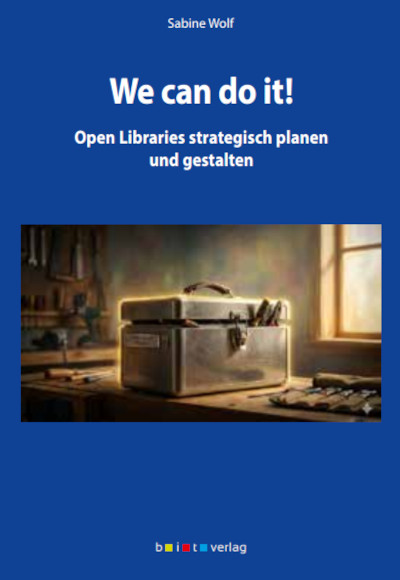
Sabine Wolf (Hrsg.)
Band 75: Denise Rudolph Band 74: Sophia Paplowski Band 73: Carmen Krause Band 72:
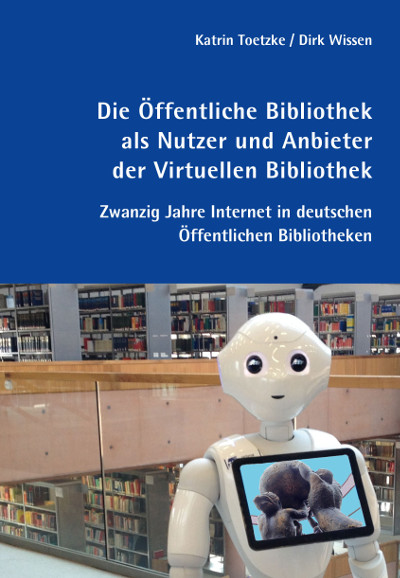
Katrin Toetzke
Dirk Wissen
Band 71: Rahel Zoller Band 70: Sabrina Lorenz Band 69: Jennifer Hale Band 68:
Linda Schünhoff
Benjamin Flämig
Band 67:
Wilfried Sühl-Strohmenger
Jan-Pieter Barbian
Band 66: Tina Schurig Band 65: Christine Niehoff Band 64: Eva May Band 63: Eva Bunge Band 62: Nathalie Hild Band 61: Martina Haller Band 60: Leonie Flachsmann Band 59: Susanne Göttker Band 58: Georg Ruppelt Band 57: Karin Holste-Flinspach Band 56: Rafael Ball Band 55: Bettina Schröder Band 54: Florian Hagen Band 53: Anthea Zöller Band 52: Ursula Georgy Band 51: Ursula Jaksch Band 50: Hermann Rösch (Hrsg) Band 49: Lisa Maria Geisler Band 48: Raphaela Schneider Band 47: Eike Kleiner
Bestellen Sie jetzt online!
15. Juni 2026
  WEITERE NEWS
Aktuelles aus
L
ibrary
Essentials

In der Ausgabe 04/2026 (Mai 2026) lesen Sie u.a.:

  • Wie verlässlich sind Metadaten für Forschungsdaten wirklich?
  • Erfundene Quellen – wie KI-Zitationen die Wissenschaft unter Druck setzen
  • Zwischen Bildschirmzeit, Stress und Lernverlust
  • Warum Bibliotheken im Zeitalter von KI wichtiger werden und mit einem Vertrauensparadox zu kämpfen haben
  • Schweden setzt in Schulen wieder auf Bücher
  • Warum KI-Kompetenz mehr sein muss als Toolwissen
  • Wie stark KI-Texte das Netz schon prägen
  • Open Access bringt Vorteile, aber nicht in jedem Fach auf die gleiche Weise
  • Was ChatGPT und Ghostwriting über Autorschaft verraten
  • Warum E-Books in US-Schulen zur Kostenfrage werden
u.v.m.
  fachbuchjournal
2009 bis 2023

New open access funding pilot for Austria

The Austrian Science Fund (FWF), the Austrian Academic Consortium (Kooperation E-Medien Österreich), the Austrian Central Library for Physics at the University of Vienna and IOP Publishing (IOP) have announced a new pilot project that will provide advance funding for Austrian researchers to publish on a hybrid open access basis in IOP's subscription journals and which will offset that funding against subscription and licence fees paid by the Austrian Academic Consortium for access to IOP's journals.  

The FWF will cover article publication charges for all authors (who meet the qualifying criteria specified by the Austrian Science Fund) when they choose to publish with IOP.  The pilot project will run for three years starting at the beginning of 2014.  It also encompasses a three-year agreement for access to IOP’s journals for participating members of the Austrian Academic Consortium.  It brings two such funding agreements - for open access publication and for access to a portfolio of journals - together for the first time.

Falk Reckling, responsible for Scholarly Communication at FWF, says: "Open Access is the future of scholarly publishing. But models and experiments are needed to migrate the current subscription system into open access.  Following the Open Access recommendations of Science Europe, the FWF is happy to present together with the Austrian Academic Consortium and IOP one of the first pilots that applies country-based reductions in journal subscriptions, in line with increases in author- or institution-pays contributions for Open Access."

Kerstin Stieg, Coordinating Director of the Central Head Office of the Austrian Academic Consortium, says: "This pilot project is outstanding and exemplary in terms of bringing together subscription agreements and Open Access and enabling their costs to be managed at a national level. With both the FWF and IOP we have found competent, reliable and strong business partners in the implementation of this ground breaking pilot. We hope and trust that this agreement will lead the way to further projects in uniting subscription agreements and open access."

Brigitte Kromp, Head of the Austrian Central Library for Physics at the University of Vienna, says: "As the University of Vienna is one of the key players in the open access movement in Austria we are very interested in developing sustainable open access models. We hope to get reliable figures for the calculation of open access fees, to manage costs nationally and find economically feasible future business models by this project. Knowing IOP for many years as a reliable partner, we considered the publisher to be best qualified for this experiment."

Steven Hall, Managing Director of IOP Publishing, said: "We are very pleased to be working on this pilot project at a national level with our Austrian colleagues.  We are aware of a growing demand from research funders and universities to look more closely at the relationship between open access publication charges and journal subscription and licence fees and believe that this initiative will provide all the partners with valuable data on how it might be made to work, at a global and local level.  We hope that this will provide an incentive for more Austrian researchers to publish in our journals."

Member institutions of the Austrian Academic Consortium are invited to join this agreement any time.